
Mining Electricity Math: Turning Watts Into Daily Cost
Three multiplications turn a wattage into a bill: joules per terahash into watts, watts into kilowatt-hours, and kilowatt-hours into money. A 250 TH/s rig at 20 J/TH draws 5 kW — 120 kWh a day, $7.20 at $0.06/kWh — against $9.12 of net daily earnings at today's difficulty of 132.76 T. Get any one of those three steps wrong and the margin you think you have is not the margin you have.

Key takeaways
- Watts × 24 ÷ 1,000 gives daily kilowatt-hours: a 5 kW rig consumes 120 kWh a day, which is $7.20 at $0.06/kWh and $14.40 at $0.12/kWh for identical hashrate.
- Power draw comes from efficiency, not from hashrate: 250 TH/s at 20 J/TH is 5 kW, at 32 J/TH it is 8 kW, and the second rig pays $11.52 a day in power against the same $9.50 of gross earnings.
- At 132.76 T and $84,692 per BTC, the network pays about $38.1 million a day across roughly 1,003 EH/s, so every miner's gross revenue is fixed by share — only the cost side is negotiable.
- Cooling, fans and power-supply losses are inside the wall meter, not inside the datasheet: measure total rack draw rather than trusting a published J/TH figure.
Definitions first
Electricity math goes wrong at the unit boundaries, so define four terms before using them. A watt is a rate of energy use. A kilowatt-hour is that rate sustained for an hour. A tariff is the price of a kilowatt-hour. And joules per terahash is the efficiency that decides how many watts your hashrate costs in the first place.
The conversion that trips people up is the first one. Watts to kilowatt-hours is not a multiplication by 24,000 or by anything a sales brochure suggests; it is watts × hours ÷ 1,000. A 2 kW rig running for 24 hours consumes 48 kWh. Run it for 30 days and the same machine consumes 1,440 kWh — which is why monthly invoices look so much larger than daily estimates and why the error is rarely in the meter.
Efficiency enters one step earlier. A rig's power draw is its hashrate multiplied by its joules per terahash, so 250 TH/s at 20 J/TH is 250 × 20 = 5,000 W. Change the efficiency figure and the entire cost column moves while the revenue column does not move at all.
The trade-off nobody prices
Mining hardware is sold on hashrate per dollar, and electricity is billed in kilowatt-hours. Those two units never appear on the same page, which is how a machine that looks cheaper can cost more to run than the one next to it. The table below puts both units in one place, with gross earnings calculated from network hashrate and the 3.125 BTC subsidy at 132.76 T difficulty.
| Setup | Power | kWh per day | Electricity per day | Gross per day | Margin |
|---|---|---|---|---|---|
| 100 TH/s at 20 J/TH | 2.0 kW | 48.0 | $2.88 | $3.80 | +$0.92 |
| 100 TH/s at 32 J/TH | 3.2 kW | 76.8 | $4.61 | $3.80 | −$0.81 |
| 250 TH/s at 20 J/TH | 5.0 kW | 120.0 | $7.20 | $9.50 | +$2.30 |
| 250 TH/s at 32 J/TH | 8.0 kW | 192.0 | $11.52 | $9.50 | −$2.02 |
| 2.5 PH/s at 20 J/TH | 50.0 kW | 1,200.0 | $72.00 | $94.98 | +$22.98 |
| 25 PH/s at 20 J/TH | 500.0 kW | 12,000.0 | $720.00 | $949.83 | +$229.83 |
Read the top two rows together, because they are the same hashrate and the same revenue. The only difference is 12 joules per terahash, and it swings a $0.92 daily profit into an $0.81 daily loss. The second trade-off is the one nobody prices at all: a cheaper efficiency figure often arrives with a hotter chip, and hotter chips cost fan power and derating in summer. Both effects land in the same meter reading.
There is also a financing angle that surfaces once the numbers get large. A 25 PH/s site at 20 J/TH draws 500 kW and spends $720 a day on electricity while earning $949.83 gross. Electricity is due monthly and reliably; mining revenue settles against difficulty and price. Pools that pay hourly, such as PPS+ at current difficulty, compress the gap between those two cycles, and a collateral-backed loan facility exists precisely for the weeks when they do not line up. Both live in one account when the hashrate points at ViaBTC Crypto Mining, which is what a multi-site operator needs when power is invoiced on a different clock to revenue.
Example with two setups
Here is the arithmetic on one machine, then on the same machine in a different condition. Take 250 TH/s. Its share of a 1,003 EH/s network is 2.49 × 10⁻⁷, and against 450 BTC produced each day across the network that is 0.00011215 BTC — $9.50 at $84,692 per BTC, or $9.12 after the listed 4% fee on the PPS-settled block-reward component.[1]
Setup one runs at 20 J/TH. Power draw is 5 kW, so consumption is 5 × 24 = 120 kWh and the daily cost is 120 × $0.06 = $7.20. Earnings of $9.12 minus $7.20 leaves $1.92 a day, about $58 a month, before hosting or repairs.
Setup two is the same machine after two years of heat, dust and a rebuilt hashboard: 32 J/TH. Power draw is now 8 kW, consumption is 192 kWh, and the bill is $11.52 a day against $9.12 of earnings. The rig is hashing perfectly and losing $2.40 a day. Over a month that is $72, which is usually more than the difference in purchase price that put the machine on site in the first place.
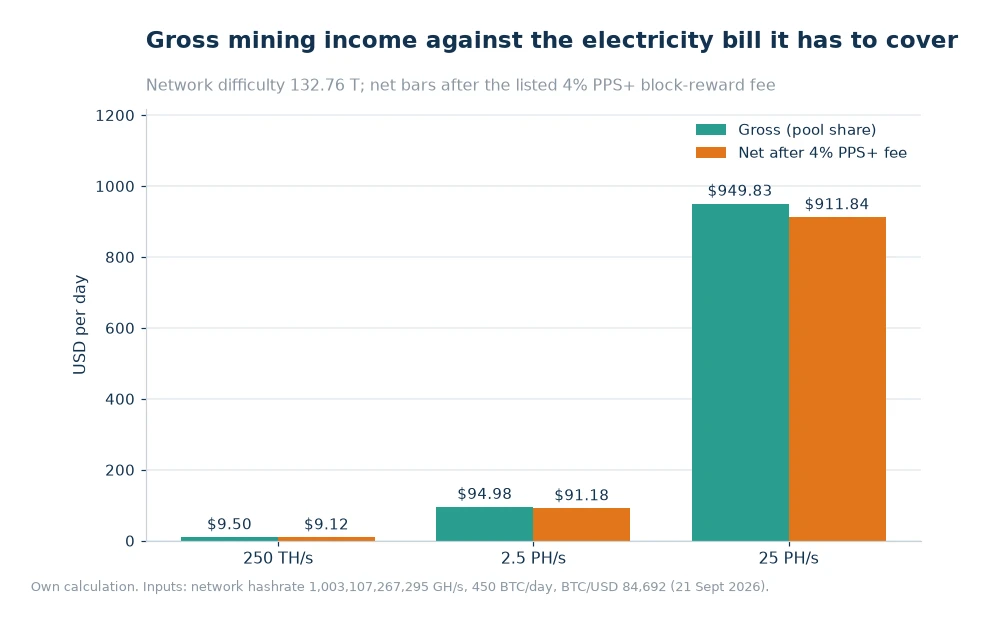
Scale the same logic to a site and the cost line becomes the business. The published example of a 10 PH/s farm on 20 J/TH machines is a 200 kW load: 4,800 kWh a day, about $288 at $0.06/kWh, against roughly $380 a day of gross mining income. That leaves about $92 a day for everything else — staff, rent, repairs, downtime — on a site earning more than $100,000 a year before costs. A profit calculator that accepts coin price, difficulty, fee rate and valid hashrate turns those site figures into one number per day, which is the number a lender or a host will ask for.
Practical next steps
- Meter the rack, not the machine. A plug-level meter tells you one rig's draw; a panel meter tells you what you pay for, including fans, transformers and losses. The second figure is the one that reconciles with the invoice.
- Convert once, in a spreadsheet. Watts × 24 ÷ 1,000 × your tariff gives a daily cost per rig. Put it beside daily revenue per rig and keep both columns current; nothing else in the operation changes as fast as those two.
- Test a second tariff. The same 250 TH/s rig at 20 J/TH costs $7.20 a day at $0.06/kWh and $14.40 at $0.12/kWh. Power price is usually the largest negotiable input you have, and it is worth more than any firmware tweak.
- Check delivered hashrate against billed energy. A pool-side mining pool dashboard shows per-worker output for the same period, so kilowatt-hours whose hashrate never reached the pool show up as a gap rather than as a mystery.
- Model the difficulty path. Revenue per terahash falls when the network grows; your wattage does not. Rerun the two columns with revenue 15% lower and see which rigs in the fleet survive.
Frequently asked questions
Is a bigger pool always better?
Size reduces payout variance but also concentrates hashrate. What matters more is fee structure, uptime, latency and payout cadence.
What happens if my miner goes offline?
Shares stop, so expected income stops with them. Alerts and a dashboard that shows per-worker hashrate shorten the gap between a failure and a fix.
Does a lower electricity price always beat a more efficient machine?
No. Halving the tariff on a 32 J/TH rig does keep it running, but it needs that discount every month forever; a machine at 20 J/TH needs no renegotiation. In practice efficient hardware plus a mid-range tariff usually beats cheap power plus inefficient hardware, because efficiency is also protection when difficulty rises.
How do I compare two tariffs fairly?
Convert both to an all-in cost per kilowatt-hour: energy charge, transmission, demand charges, cooling and any minimum take-or-pay volume. Then multiply by your metered kWh for the same period. Contract headline rates are not comparable units.
Write the cost column first
Spend twenty minutes turning your fleet's wattage into a daily figure, then hold it against the daily revenue column from current difficulty. The rigs that survive that comparison are the ones worth keeping powered, and the ones that do not are a decision rather than a surprise. Repeat it monthly — efficiency drifts down, difficulty drifts up, and the meter never renegotiates.
Data and sources: network difficulty and hashrate from public chain data, ViaBTC pricing, settlement rules and calculators[1][2]. All figures use 1,003,107,267,295 GH/s of network hashrate, 450 BTC mined per day, a 3.125 BTC subsidy, a $84,692 BTC price and a $0.06/kWh tariff, read on 21 September 2026. Illustrative arithmetic; earnings change with difficulty and price.