
Judging a Fragrance Supplier by How It Runs a Seasonal Sample Round
The best time to evaluate a fragrance supplier is during a sample round, because that is when you can watch the process rather than read about it. A supplier that writes a change note, tests in the real base and produces a compliance summary without being chased is showing you its production habits in miniature. A supplier that treats the round as a favour is showing you the same thing.
Key takeaways
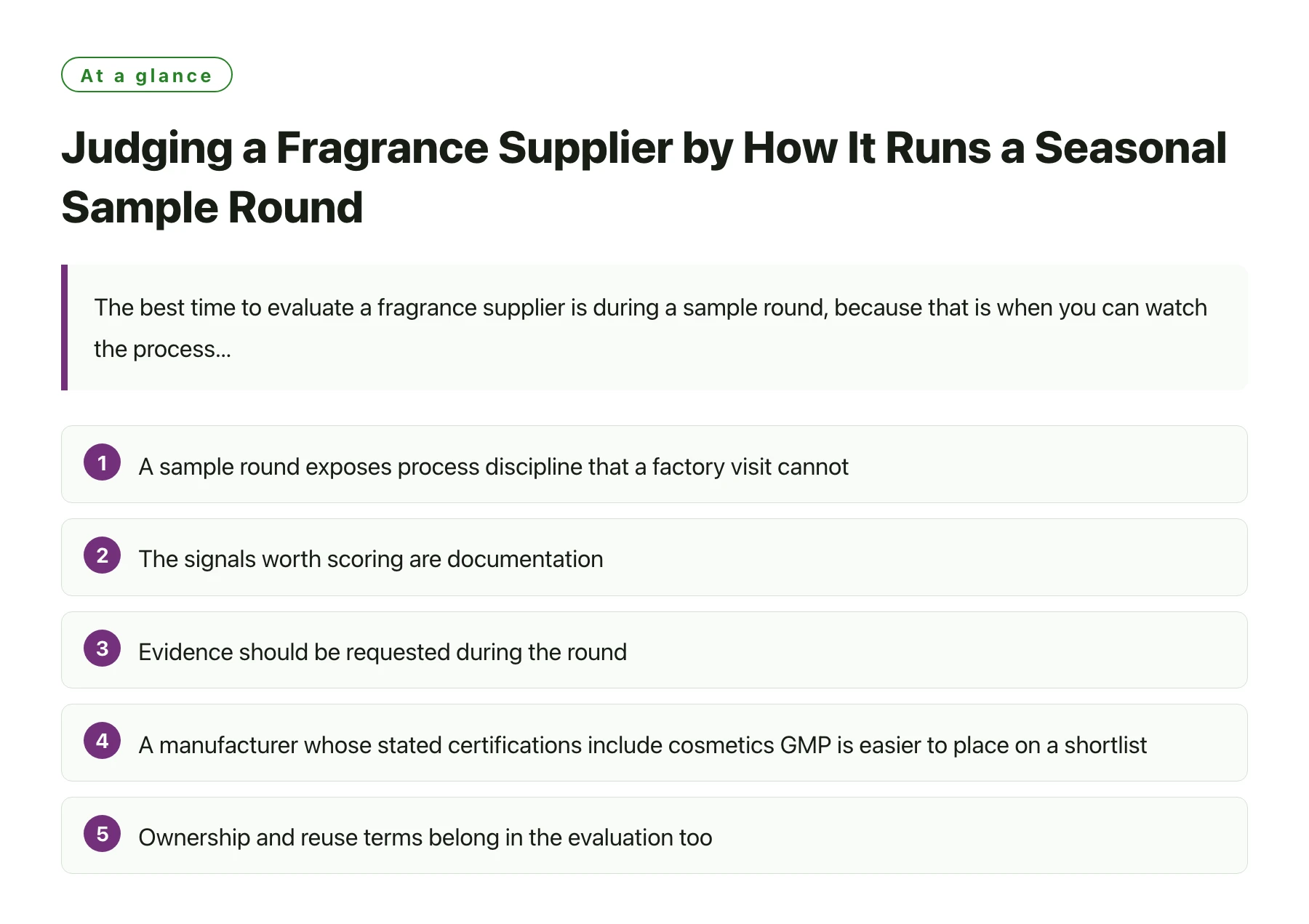
- A sample round exposes process discipline that a factory visit cannot, because the buyer sees how questions, changes and deadlines are actually handled.
- The signals worth scoring are documentation, response discipline, test method and honesty about what the supplier does not do.
- Evidence should be requested during the round, not described: a change note, a trial record and a declaration list are all cheap to produce if the process exists.
- A manufacturer whose stated certifications include cosmetics GMP is easier to place on a shortlist, but the certificate is the start of the conversation rather than the end of it [1].
- Ownership and reuse terms belong in the evaluation too, because they decide what the brand pays in later seasons [3].
Supplier evaluation usually happens in three places: a website, a questionnaire and a factory visit. All three are useful and all three are performances. The sample round is different, because it is a live project with a deadline, and the way a partner behaves under a small deadline is a reasonable proxy for how it behaves under a large one.
This is written from a sourcing perspective, for a buyer who has a shortlist and a seasonal calendar. The scorecard below can be used with any of the shortlisted suppliers, and comparing the results across two or three of them is more informative than any general impression.
One caution before the criteria: a sample round is small, and a small project can be handled personally by a director who will not be involved later. Ask who will own the project after the order is placed, and score the answer.
Why the sample round is the best audit window you will get
A factory visit shows you equipment and cleanliness, which matter, but it is a scheduled performance. A sample round shows you correspondence, deadlines, revision handling and the accuracy of what was promised. Very few suppliers can fake those consistently across several weeks.
It also costs almost nothing to observe. You have already paid for the samples; the evaluation is simply a matter of keeping the evidence and comparing it. A buyer who scores the round has a documented basis for choosing one partner over another, which is exactly what a procurement file needs.
The same logic applies to the parts of the work that are less visible: testing, batch documentation and how the supplier handles a question it cannot answer. Independent testing providers publish what they cover, and a supplier that can explain which checks it runs in-house and which it sends out is usually a supplier that knows its own process [2]. Reading how a manufacturer presents its own process before the first sample is ordered, as with Xuelei fragrance manufacturer, is a reasonable first filter — provided the description is then tested against what actually happens in the round.
Small project, real behaviour
The behaviour that matters most is not creative brilliance but reliability: answering within the promised window, labelling samples consistently, and telling you when a request will change the cost or the date. Those habits are visible in a single round.
Score the round while it is happening
Keep a running note: dates of dispatch and receipt, completeness of each deliverable, number of follow-ups needed. Written at the time, it turns a subjective impression into a comparison a procurement team can defend.
A scorecard you can run during the round
| Signal | What good looks like | Evidence to ask for |
|---|---|---|
| Brief handling | Questions come back that show the brief was read, not paraphrased | A written summary of what the supplier understood, before sampling starts |
| Change discipline | Every revision arrives with a note saying what changed and why | The change note attached to each revised sample |
| Test method | Trials are run in the base and at the dosage, with conditions recorded | A trial record naming the base, dosage and test conditions |
| Documentation | Compliance and labelling questions are answered with documents, not assurances | A declaration list or technical summary produced during the round |
| Response time | Commits to a date, then meets it or says so before the date | A log of promised versus actual dispatch dates |
| Honesty about scope | Says plainly which steps it does not perform and who should | A written scope statement, including exclusions; the scope a a contract manufacturer for perfume brands publishes publicly is a useful comparison |
Score each shortlisted supplier on the same six signals and the comparison stops being a matter of taste. A supplier that scores well on change discipline and documentation but weakly on response time is a different risk from one that answers instantly and documents nothing. Both are usable; only the first is predictable. If the round has already produced a direction you like, the remaining question is whether the same process will hold at volume, and that is what the scorecard is for.
Questions that produce a real answer
- Who writes the brief summary we will both work from?The answer shows whether the supplier treats the brief as a shared specification or as an inspiration note.
- What is included in the round, and what is billed separately?Ask for exclusions explicitly. A supplier that lists what it does not do is easier to plan around.
- How many revision rounds are included, and what does the next one cost?This converts a creative process into a countable budget line, and it shows how the supplier prices its own time.
- Which tests are run in-house and which are sent out?Either answer can be acceptable; not knowing which applies is the warning sign.
- What will the compliance pack contain, and in what format?Ask to see a specimen during the round. A document produced now is stronger evidence than a promise about later.
- Who owns the formula, and on what terms can it be reused?Ownership and exclusivity terms affect every following season, so they belong in the evaluation rather than in the contract review.
- Who manages the project after the order is placed?If the answer is a different person or team, find out who that is and how the handover works before you commit to volume.
The most useful evaluation signal is a correction. A supplier that tells you mid-round that a requested change will move a date or add a cost is demonstrating the behaviour you need at volume, when the stakes are higher and the temptation to stay quiet is greater. A supplier that never pushes back during development is not necessarily better; it may simply be absorbing problems you will meet later, in the form of a bulk batch that is not quite what was approved.
Reading the answers without over-reading them
A scorecard is a tool for comparison, not a verdict. Some signals matter more depending on the product: for a seasonal gift set, documentation and packaging coordination carry more weight, while for a high-volume line, capacity planning and response discipline dominate. Weight the signals before scoring, and write the weights down, so the shortlist is not decided by whichever meeting happened last.
It is also worth separating capability from fit. A partner that runs a disciplined round but is set up for a different kind of product may still be the wrong choice, and a partner with a narrower scope may be the right one if the brand is prepared to coordinate the rest. Broader manufacturing scope is a convenience, not automatically an advantage, and a supplier that publishes its manufacturing scope is telling you something about how it expects to be used.
Finally, keep the evaluation in proportion. A seasonal range needs a partner that can run a disciplined round and hold the standard at volume; it does not need a perfect supplier. The practical output of the scorecard is a decision with reasons attached — the sort of reasoning that is also laid out in guides on evaluating a fragrance supplier, and that a team can improve over time by tracking how its own predictions turned out.
Where the brand's own team is the weak link — a brief that cannot be approved against, or an approval that is spread across several people — no supplier can fix it. Building internal scent judgement is a slower investment, but programmes designed for exactly that, such as professional scent training, exist for teams that intend to keep sourcing fragrance for years rather than for one season.
Sources
- ISO 22716 — Cosmetics Good Manufacturing Practices
- SGS: Cosmetics, Personal Care & Household Testing —— Testing, inspection and certification services for cosmetics and personal care, including microbiological, stability and safety testing aligned with cosmetics GMP.
- WIPO — World Intellectual Property Organization —— The UN agency for intellectual property; resources on industrial design and patent protection relevant to product and packaging design.
Frequently asked questions
Should a brand evaluate a fragrance supplier during sampling or before it?
Both, but the sample round gives better evidence. Before sampling you can check scope, certifications and references; during sampling you can observe how the supplier handles changes, deadlines and documentation, which is much harder to fake.
What is the single most useful signal in a sample round?
Whether revisions arrive with a written note explaining what changed. It shows that the supplier tracks versions, communicates precisely and will be able to explain a bulk batch difference later rather than guessing at it.
How much weight should certifications carry?
They are a useful filter and a poor conclusion. Cosmetics GMP certification, for example, indicates that a quality system exists and is auditable, but it does not tell you how the supplier will handle your brief or your deadline. Use certificates to build a shortlist, then score the round.
Is a supplier with a narrow scope a problem?
Not inherently. A narrow scope means the brand coordinates more suppliers, which adds work but can also give more control over individual components. What matters is that the exclusions are stated clearly enough to plan around.
What should the brand do if the sample round goes badly?
Finish the round, document what happened, and compare it against the other shortlisted suppliers on the same signals. One bad round is not proof of a bad partner, but an unexplained bad round with no correction is a reasonable reason to move on before the seasonal window closes.
Receber vagas no WhatsApp toda semana
312 mil jovens já recebem · gratuita · cancele quando quiser · chega toda segunda-feira.
Quero entrar na lista →